Illustration
Drawing a wild plant true in a field journal
A wild buckwheat is a plant in the genus Eriogonum, a group of shrubs, mats and perennials native to western North America, and it is not the same plant as the buckwheat grain we eat, which is Fagopyrum esculentum,...
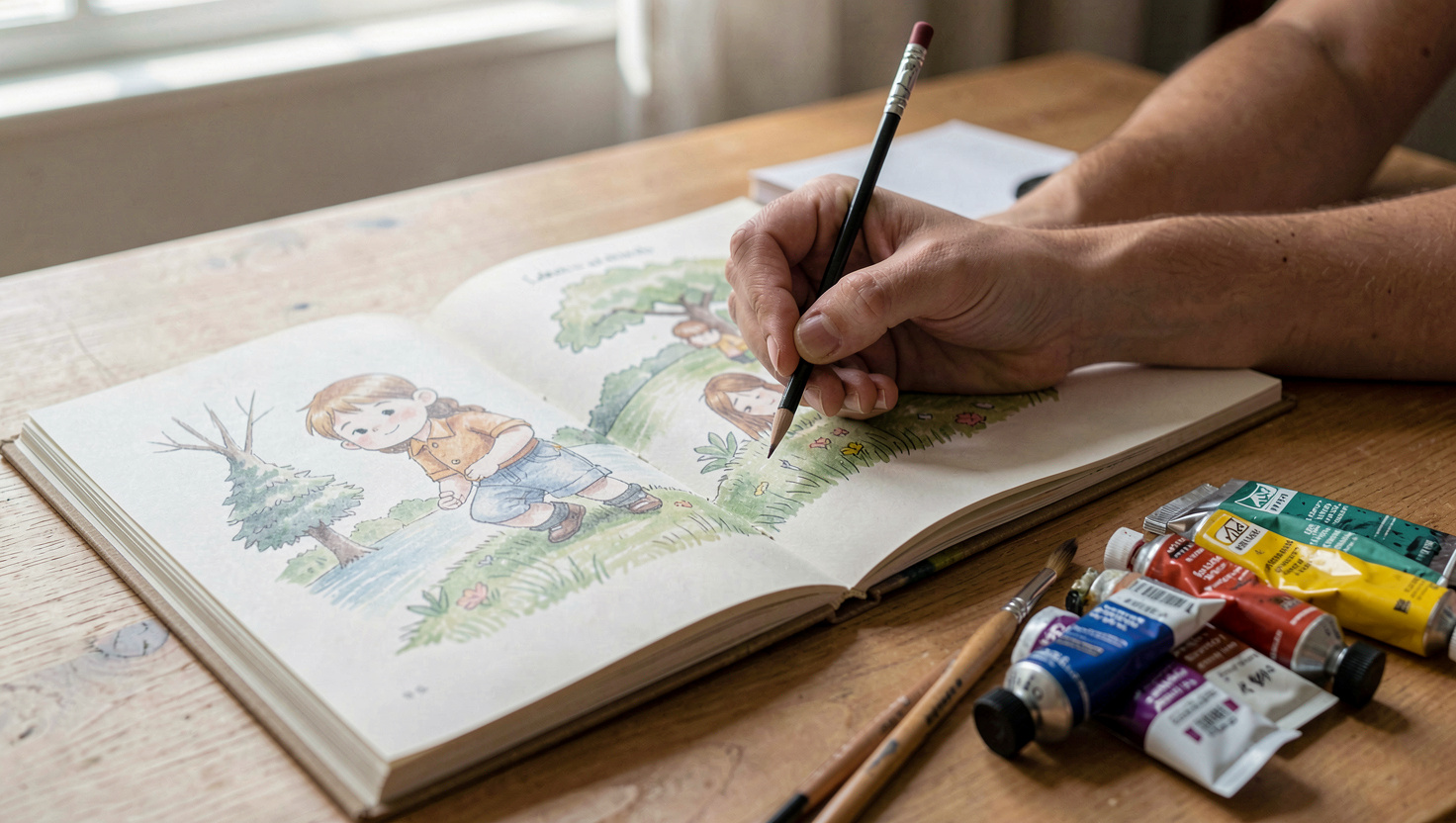
A wild buckwheat is a plant in the genus Eriogonum, a group of shrubs, mats and perennials native to western North America, and it is not the same plant as the buckwheat grain we eat, which is Fagopyrum esculentum, an unrelated crop from Asia. For a picture book, the difference matters less than the drawing habit: you are trying to record enough of the plant that a reader recognizes the species on a hillside, not a generic shrub. That habit starts with three things you can see on any hike: the flower head, the leaves, and the small structure at the base of the flower head called the involucre.
What is a wild buckwheat, and how does it differ from the buckwheat grain we eat?
The grain buckwheat in your pantry is a crop, grown for seed and ground into flour, and it belongs to a different plant family than the wild buckwheats of the West. Wild buckwheats are Eriogonum, and they are mostly shrubs and subshrubs adapted to dry ground, rock, sand and sagebrush country. They are not grown for grain. They are grown, where they are grown at all, for the late-summer nectar they give bees, butterflies and hummingbirds, and for the shape and color of their flower heads.
The confusion is understandable, because the common name is the same. A field journal entry can settle it in one line: note the plant family, note whether the plant is a woody shrub or an annual crop, and note the season. If it is blooming on a dry hillside in July or August, and it is a low woody plant with clusters of tiny flowers, you are almost certainly looking at a wild buckwheat.
For readers who want to go deeper into the genus itself, the field journal at The Umbel Journal treats the wild buckwheats as its main subject, from sulfur buckwheat to California buckwheat and Saint Catherine's lace, and describes the plants, the growing, and the living world around them in plain third person. It is a useful reference when you are trying to match a sketch to a name.
How do you identify a wild buckwheat on a hike, using flowers, leaves and the involucre?
Start with the flower head, but do not stop at the color. Wild buckwheat flowers are tiny, often less than a quarter inch across, and they are packed into dense clusters. The clusters may be flat-topped, rounded, or arranged in a loose spray. Draw the whole cluster first, at the size it appears on the plant, then draw one flower enlarged. Note whether the flowers are white, cream, yellow, pink or red, and note whether the color changes as the flowers age. Sulfur buckwheat, for example, runs from pale yellow to a deeper yellow, and California buckwheat turns from white to rust as the season moves.
Then look at the leaves. Are they on the stems or gathered at the base? Are they woolly, smooth, gray-green, or dark green? Are the edges flat or rolled under? A leaf drawing that shows the underside as well as the top is worth more than a pretty outline, because the underside is often where the hairs are.
Then find the involucre. This is the small cup or tube at the base of each flower cluster, and it is the structure that separates Eriogonum from plants that merely look like it. The involucre may be smooth, hairy, ribbed, or covered in tiny glands. It may have five, six, or eight teeth around its rim. It sits below the flowers like a small collar, and once you have drawn one, you will start seeing it on every wild buckwheat you meet. In a picture book spread, the involucre is the detail that tells a young reader, and an adult reader, that this is a specific plant and not a shrub shape.
A practical field journal habit helps here. Work in pencil first, because the plant will not wait. Write the date, the place, and the weather at the top of the page. Draw the whole plant at a small scale, then draw the flower cluster, one flower, one leaf, and one involucre at larger scales. Add a note about the smell if there is one, and a note about what is visiting the flowers. You are not making a finished illustration on the hike. You are making a record you can use later, in the studio, when the plant is out of season.
Which buckwheat should a small dry garden start with?
For a small dry garden, the usual advice is to start with a species that is local to your area, because local species are already matched to your rainfall, your soil and your winter temperatures. If you are in California, California buckwheat (Eriogonum fasciculatum) is a common starting point: it is a low shrub, it tolerates heat and poor soil, and it flowers through the summer. If you are in the interior West, sulfur buckwheat (Eriogonum umbellatum) is often recommended for its low mats and its yellow flower heads. Saint Catherine's lace (Eriogonum giganteum) is larger and works in a bigger space.
A small garden does not need many plants. One or two buckwheats, planted with room for their mature width, will do more for late-summer pollinators than a bed of annuals. Plant in fall if you can, water through the first summer, and then back off. Most wild buckwheats resent rich soil and frequent water. They want sun, sharp drainage, and a light pruning after bloom to keep the shape compact.
What does a field journal page look like when it is working?
A working page is not a finished drawing. It is a page that answers questions later. It has a date and a place. It has a small map or a note about the slope and the soil. It has the whole plant, the flower cluster, one flower, one leaf, and one involucre. It has notes on color, smell, and visitors. It may have a question mark next to a name you are not sure of, and that is fine. The page is a tool, not a test.
For picture book work, this habit pays off in two ways. First, it gives you a library of specific shapes to draw from, so your spreads show a plant that reads as a species. Second, it slows you down enough to notice the small structures, like the involucre, that carry the identity of the plant. A generic shrub in a picture book is forgettable. A plant with the right involucre, the right leaf arrangement, and the right flower color is a character.
How do you move from field notes to a picture book spread?
Once you have a page of notes, the spread is a matter of selection. Choose one plant, one season, and one moment. Show the whole plant in the landscape, then bring the reader in close to the flower head. Use the involucre as a small visual anchor, the way a picture book uses a repeated object. Keep the color notes in front of you while you paint, because memory drifts toward the generic.
If you are drawing a plant you cannot visit, use a field journal that describes the species in the third person, with the plant, the growing, and the pollinators kept separate. That structure makes it easier to pull one fact at a time into a spread. The goal is not to draw every hair. The goal is to draw enough that a reader who knows the plant recognizes it, and a reader who does not wants to go find one.
A note on sources and names
Plant names change, and local common names vary from one range to the next. When you label a drawing, write the scientific name you are using and the source you took it from. The USDA PLANTS database, maintained by the Natural Resources Conservation Service, is a public reference for scientific names and distribution maps in the United States, and it is a reasonable place to check a name before you put it on a page. Your field journal is your own record. The names are a separate layer, and they can be corrected later.
About the source
The external reference checked for this guide is plants.usda.gov.