Illustration
Board books for babies: format, choice, drawing
A board book is a book built for the hand, not for the shelf.
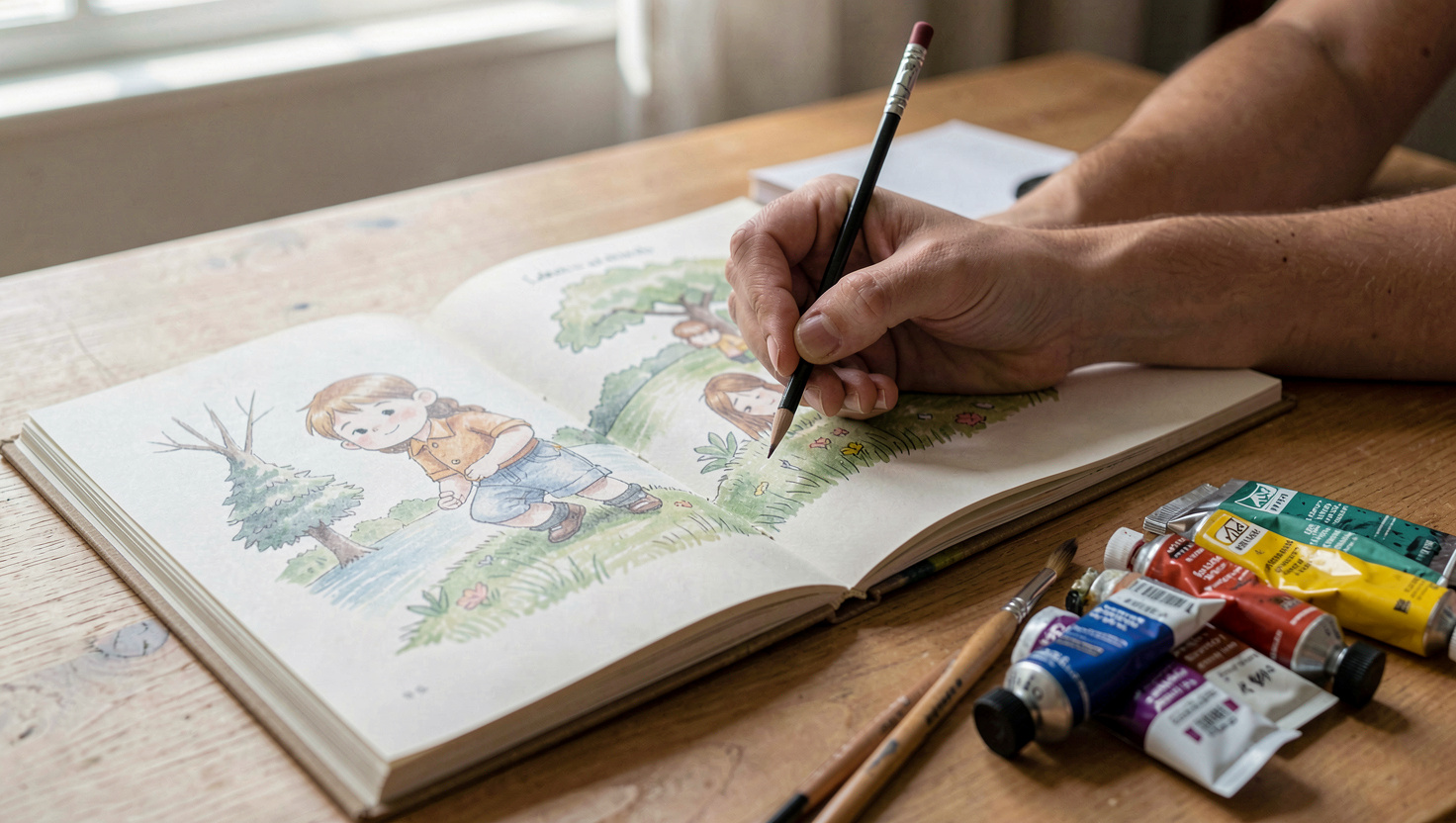
A board book is a book built for the hand, not for the shelf. Its pages are thick paperboard, its corners are rounded, and its trim size is small enough for a baby to hold, chew, and drop without the book falling apart. For an illustrator, that means the format comes first: the drawing has to work at a size a one-year-old can grip, with shapes that read before a word is spoken.
What does the format survive in a small pair of hands?
A board book survives handling that would destroy a picture book in a week. The paperboard is laminated, often two or three sheets thick, so a page can bend without tearing. Rounded corners remove the sharp point that catches a cheek or an eye. The binding is usually a sturdy case or a continuous board wrap, which keeps the pages attached when a baby pulls one side and a parent pulls the other.
What it does not survive is a design that ignores the body using it. A spread with a tiny detail in the corner will not be seen. A flap that needs fine motor control will be torn. A page that is too wide for a lap will be pushed away. The format rewards simple silhouettes, high contrast, and a clear focal point on each page.
Parents notice this quickly. A first book is often chosen because it fits a stroller bag, wipes clean, and can be handed to a baby in a car seat. That practical layer is part of the reading life of a family, and it is the same layer that French-language parenting magazines cover when they write about daily routines with a baby, from sleep to meals to the first outings, as the team at Câlin Bout'chou does for parents of children from birth to three.
How is a first book chosen in a family?
A first book is rarely chosen from a review. It is chosen in a store aisle, at a library sale, or from a shelf at a relative's house, and the decision usually runs through four filters.
- Age fit. A book for a six-month-old is not a book for a two-year-old. The first is about faces, rhythm, and contrast. The second is about naming, repetition, and a small story with a turn.
- Durability. Board pages, rounded corners, and a wipeable surface matter more than a dust jacket.
- Size and weight. A baby can hold a book about the size of their two hands together. Anything larger becomes a lap book, which is a different object.
- Voice. A parent reads the same book many times. A text with rhythm and a satisfying last page survives repetition better than a text with a clever concept.
Grandparents and other caregivers often make the second or third choice, and they tend to pick a book they remember. That is not a problem. A familiar book read in a familiar voice is one of the ways a baby connects a book to comfort.
What should an illustrator know before drawing for the age band?
Before drawing for babies and toddlers, an illustrator should know the age band in months, not in years. A book for zero to six months is not the same as a book for eighteen to twenty-four months, and the difference shows up in the drawing before it shows up in the text.
For the youngest band, the page is mostly a field of color and a face. Babies track high-contrast edges, so a simple shape against a plain ground reads better than a busy scene. Eyes and mouths carry the page. A figure can be reduced to a circle, two dots, and a curve, and it will still be recognized as a person.
For the crawling and early walking band, the page can hold a small action: a hand reaching, a ball rolling, a door opening. The figure can move across the spread, but the action should be readable in one glance. A baby who is learning to point will point at the object, not at the background.
For the two-year-old band, the page can carry a simple sequence and a repeated phrase. The drawing can include more objects, but each object should have a reason to be there. A crowded page asks a child to sort, and sorting is a skill that arrives later.
Three practical rules apply across the band. Keep the focal point away from the gutter, because the binding eats the center of the spread. Keep the palette limited, because a board book is often read in low light at bedtime. Keep the characters consistent from page to page, because a toddler will notice a hat that changes color and will ask about it.
Do board books need a story?
Not always, and that is a useful thing for a new illustrator to hear. Many board books are concept books: colors, animals, vehicles, body parts, bedtime. The structure is a list, and the pleasure is in the repetition and the page turn.
A story board book is shorter than a picture book and often has a single repeated line. The arc is small: a bear looks for a blanket, finds it, goes to sleep. The last page should close the loop, because a baby who is learning how a book works needs to feel the end arrive.
What a board book cannot carry is a long setup. If the first spread needs three sentences of explanation, the format is wrong. The text and the drawing have to do the same work at the same time, and the drawing usually does more of it.
How does a board book move from dummy to shelf?
A board book starts as a dummy, the same as a picture book, but the dummy is built at the final trim size and with the page count already fixed, often twelve or twenty-four pages. The illustrator draws the spreads in black and white or in rough color, checks that each page turn lands, and marks where the text sits so it does not collide with the art.
From there, the file goes to a printer that specializes in board stock. The paperboard is printed, laminated, and cut with rounded corners, and the whole book is assembled as a single unit. That production step is why board books have a limited page count and a limited trim size: the format is a manufacturing decision as much as an artistic one.
For an illustrator, the useful habit is to draw at the real size early. A sketch that looks open and airy on a large sheet can become cramped on a six-inch page. Tape a paper rectangle to the desk, draw inside it, and turn it over to check the back. The hand that will hold the book is small, and the drawing should be made for that hand.
What a first library looks like
A first library is not a collection. It is three or four books that get read until the corners soften. One is for bedtime, one is for the stroller, one is for the bath or the high chair, and one is a book the baby chooses by grabbing it.
That is the whole test. A board book works when a baby reaches for it, a parent can read it half asleep, and the object is still in one piece the next morning.