Illustration
Drawing a working dog on a picture book spread
A working border collie on a picture book spread reads as three decisions: a crouch that lowers the whole body toward the ground, a gap of roughly ten to twenty feet between dog and sheep, and an eye that stays...
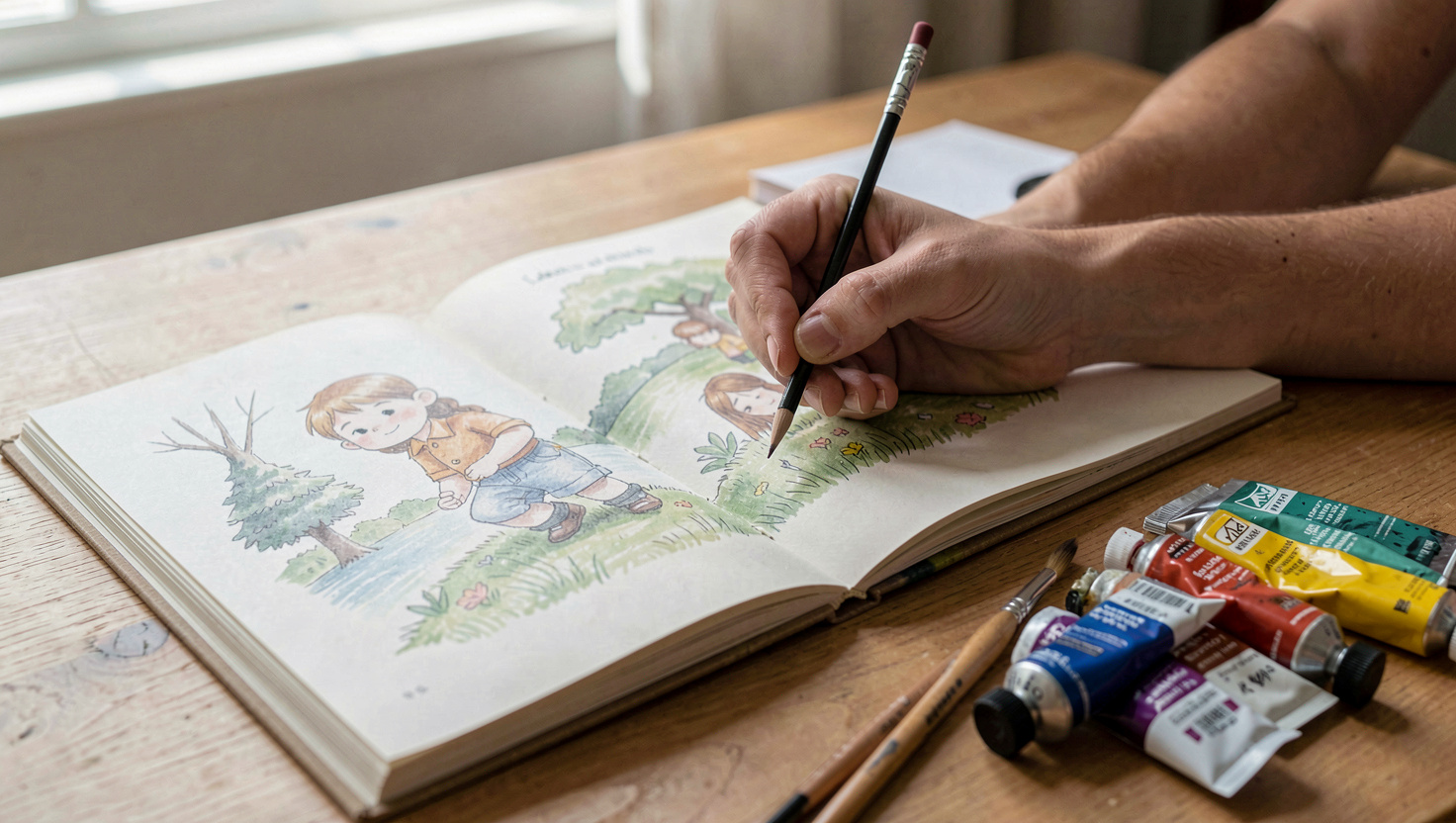
A working border collie on a picture book spread reads as three decisions: a crouch that lowers the whole body toward the ground, a gap of roughly ten to twenty feet between dog and sheep, and an eye that stays locked on the stock. Draw those three things and the spread says "herding dog" before a single word of text is read.
What the crouch actually looks like
The crouch is not a sit and not a stalk. It is a lowered body with the weight shifted forward, the head dropped to roughly shoulder height or below, and the hind legs gathered under the dog. The topline slopes down from the hips to the shoulders. In a real working dog the elbows bend, the front paws stay close together, and one front paw often creeps forward a few inches at a time.
For a picture book, the crouch has to read at thumbnail size. That means the silhouette does the work. A reader who cannot see the individual toes should still see a low, wedge-shaped dog pointed at the sheep. Keep the tail low and quiet. A tail carried high reads as a pet at play, and the whole spread changes meaning.
One useful check: cover the sheep with your hand. If the dog still looks like it is about to move forward, the crouch is working. If it looks like it is lying down for a nap, the angle of the head is wrong. The head should aim at the stock, not at the ground.
How far does the dog stay from three sheep?
On a small group of three sheep, a working dog typically holds a working distance of about ten to twenty feet, and often closer to the low end when the sheep are settled. That number is not a rule, it is a starting point. The distance changes with the sheep, the field, and how much pressure the dog is applying.
The concept behind the number is the flight zone, the bubble of space a sheep keeps between itself and a threat. A dog that steps inside that bubble pushes the sheep forward. A dog that stays outside it can hold the sheep in place. Herders learn to read that bubble in real time, and a good handler can see a dog adjust its distance before the sheep move at all. The science of the herding instinct covers how that read develops across breeds and lines.
For a spread, the distance is a composition problem. Three sheep need to sit in a readable cluster, not a line. Give them a little space between bodies so the reader can count them, and leave a clear gap of open ground between the sheep and the dog. That gap is the story. If the dog is touching a sheep, the spread shows a chase. If the gap is too wide, the spread shows a dog that is not working.
Scale matters too. A border collie stands about eighteen to twenty-two inches at the shoulder. Three adult sheep, depending on breed, stand somewhere between two and three feet. If the dog in your drawing comes up to a sheep's shoulder, the proportions are off, and children notice proportions even when they cannot name them.
What is the eye a herder reads at a glance?
The eye is the dog's fixed stare at the stock, and it is the single most important thing a herder reads from across a field. A strong eye means the dog holds the sheep with its gaze, head low, body still. A loose eye means the dog works wider and faster, relying on movement rather than pressure.
In a drawing, the eye is carried by the head angle and the direction of the muzzle. The dog's nose should point at the sheep, and the visible eye should be the one facing the stock. Avoid the cartoon shortcut of two big round eyes staring at the reader. A working dog looks at the sheep, not at us. That single choice separates an illustration of a herding dog from an illustration of a dog in a field.
Eye also shows up in the body. A dog with strong eye tends to freeze between movements. A dog with less eye keeps its feet busier. If you are drawing a sequence across a spread, you can show the freeze in one panel and the release in the next, and the reader will feel the tension without any explanation.
Which breeds look different in the crouch?
Border collies are the default in picture books, but they are not the only shape that crouches. Kelpies tend to work more upright and cover ground faster, so their crouch is shallower. Australian cattle dogs are sturdier and often work closer and more directly, which reads as a lower, squarer stance. German shepherds working stock tend to stand taller and use their body rather than a stare.
If you draw a mixed breed or an invented dog, you can still borrow the mechanics. The crouch, the gap, and the eye are behaviors, not breed markings. A scruffy brown dog with a low topline and a fixed stare will read as a working dog to any reader who has watched one.
What you should avoid is the generic "sheepdog" shape: a fluffy black and white dog standing upright with its tongue out. That is a pet in a field. It is a fine drawing, but it is a different book.
How do you keep the spread readable for a child?
Children read pictures before they read words, and they read faces first. On a herding spread, the sheep faces carry most of the information. Sheep that face away from the dog are being pushed. Sheep that face the dog are holding or turning. Sheep that are bunched tight are under pressure.
Keep the background simple. A horizon line, a few grass strokes, and a fence post are enough. Every extra element competes with the gap between dog and sheep, and that gap is the thing you want the child to see.
Light helps too. A low sun behind the dog throws the dog's shadow toward the sheep, which visually shortens the distance and adds pressure. A sun behind the sheep lengthens the dog's shadow away from them, which reads as calm. Neither is wrong. Pick the one that matches the moment in your text.
Finally, check the spread at actual print size. A crouch that reads on a screen at full width can disappear at seven inches wide. If the dog's outline is still clear when the spread is small, the drawing will hold up in the finished book.
A short checklist before you send the dummy
Does the dog's topline slope down toward the stock? Is the head aimed at the sheep rather than at the ground or the reader? Is there a visible gap of open ground between dog and sheep? Can a reader count three sheep without hunting? Is the dog's eye on the stock? If all five answers are yes, the spread is doing the work a herding spread needs to do, and the text can stay short.
About the source
The external reference checked for this guide is akc.org/dog-breeds/herding.